Who pays your medical bills when the driver who hit you has little or no insurance? You may have assumed their insurance would cover your injuries, only to learn there is no policy or that its limits fall short of your treatment costs. Peoria uninsured/underinsured motorist accident lawyer Joel E. Brown can help you understand whether your own auto policy offers coverage and how to pursue a claim.
With 34 years of experience representing injured people throughout the Peoria area, Joel handles every case himself. You can discuss your concerns directly with the attorney handling your claim, including what coverage may be available as you continue treatment.
Joel E. Brown, P.C. handles uninsured motorist (UM) and underinsured motorist (UIM) claims for people hurt in crashes across Peoria and the surrounding metro. When you hire this firm, you hire Joel himself, and he reads your policy with you before you sign anything an adjuster sends.
Call (309) 673-4357 for a free consultation about what your own policy covers.
Why Is a UM or UIM Claim Different From Other Injury Claims?

A UM or UIM claim differs because you are asking your own insurer to pay under a contract you bought, not a stranger’s insurer for its driver’s mistake. The company that collected your premiums now decides what your injury is worth.
That shift changes the work. Fault still matters, but policy language often decides the case, from who counts as an insured to how much the insurer can deduct. Handling that alone means negotiating against a company that already holds your file and its own reading of the contract.
What Illinois Requires in Every Auto Policy
Illinois requires uninsured motorist coverage in every auto liability policy, at no less than $25,000 per person and $50,000 per accident for bodily injury. Under 215 ILCS 5/143a-2, your UM limits must match your bodily injury liability limits unless you chose lower limits or, in writing, rejected the higher amount.
Underinsured coverage becomes part of your policy once your UM limits exceed the state minimum, and it is written in the same amount as your UM coverage. Many Illinois drivers carry both without realizing it until they need it.
When Does Uninsured or Underinsured Motorist Coverage Apply?
Uninsured motorist coverage applies when the at-fault driver has no liability insurance or flees the scene, and underinsured coverage applies when the at-fault driver is insured but carries lower limits than your UIM coverage. Here is how the two compare:
| Question | Uninsured motorist (UM) | Underinsured motorist (UIM) |
| When it applies | The at-fault driver has no liability insurance, or a hit-and-run driver injures you | The at-fault driver’s bodily injury limits are lower than your UIM limits |
| What it pays | Your damages, up to your UM limits | Your UIM limits, minus what you actually recover from the at-fault driver’s insurance |
| Required in Illinois? | Yes, in every auto liability policy | Yes, once your UM limits exceed the state minimum |
| Where the limits come from | Equal to your liability limits unless you chose lower limits in writing | Equal to your UM limits |
Illinois liability minimums are $25,000 per person, $50,000 per accident, and $20,000 for property damage, according to the Illinois Department of Insurance. A driver carrying only those limits can leave a seriously hurt person tens or hundreds of thousands of dollars short, and UIM coverage exists to close that gap.
Coverage Can Follow You, Not Just Your Car
Depending on how your policy defines an insured, UM and UIM coverage can cover you as a pedestrian or cyclist, not just as a driver. That is why Joel asks early who in your household carries what, since the policy that pays is not always the one on the vehicle in the crash.

The Procedural Traps That Sink UM and UIM Claims
Several rules specific to these claims catch people who handle them alone, and none of them appear in the letters an adjuster sends:
- Many policies require you to notify your own insurer before you settle with the at-fault driver’s insurance company, and settling first without that notice can put the underinsured claim at risk.
- Your UIM limits are reduced by the amounts you actually recover from the at-fault driver’s policy, which is why a $100,000 limit rarely means $100,000 in hand.
- Illinois law includes arbitration in UM coverage, and many policies use the same process for UIM, so disputes usually go to neutral arbitrators instead of a jury, on a different timeline and with narrower discovery.
- The filing deadline often comes from your policy rather than the two-year injury statute, and many policies require you to file a lawsuit or arbitration demand within two years of the crash.
One Illinois rule works in your favor. Under 215 ILCS 5/143a, if the other motorist fails to file the required forms with the Safety Responsibility Section of the Illinois Department of Transportation within 120 days of the crash, the law presumes that motorist was uninsured, which takes an early burden off you.
A settlement signed at the wrong moment can cost you coverage you already paid for. Joel reads the actual policy language at the start of every UM and UIM case so that does not happen.
Why Peoria Drivers Trust Joel E. Brown With Uninsured Motorist Claims
A claim against your own carrier requires steady, documented work because that company already holds your file, your payment history, and its own view of what your claim is worth. Joel builds these claims on the policy language and the records, not on how a phone call with the adjuster feels.
- You hire Joel, not a firm. Joel E. Brown, P.C. is his practice, and he handles your claim personally rather than handing it to a case manager.
- 34 years in practice. Joel has practiced law since 1992 and is licensed in Illinois and Missouri.
- A flat contingency fee. The percentage doesn’t increase if your claim moves to arbitration or court.
- In-person meetings. Joel aims to sit down with qualified callers within one business day, and he will come to you if getting to downtown Peoria is hard.
- Early pressure on serious cases. When the injuries are severe, Joel moves a claim toward a formal demand, arbitration, or suit early rather than waiting on the insurer’s timeline.
Joel puts his approach simply: “I can’t do anything about what happened yesterday, but I can affect your tomorrow.” Every claim turns on its own facts and policy language, and no lawyer can promise a particular result.
Call (309) 673-4357 to schedule a free consultation with Joel.
How Does Shared Fault Affect a UM or UIM Claim?
Shared fault reduces a UM or UIM recovery the same way it reduces any Illinois injury claim. Under the state’s modified comparative fault rule, you can recover only if you were not more than 50% responsible, and your damages shrink by your percentage of fault.
A Worked Example
Say an uninsured driver runs a stop sign and hits you, and your damages total $80,000. If an arbitrator finds you 20% at fault for speeding, your award drops by $16,000 to $64,000, still subject to your UM limits. If you were found 51% at fault, you would recover nothing.
Your own insurer will look closely at fault, because every point assigned to you lowers what it pays. Careful documentation of the crash helps address that review.

What Happens in a Hit-and-Run or Phantom Vehicle Case?
A hit-and-run crash usually becomes an uninsured motorist claim, because the fleeing driver cannot be identified or sued, which leaves your own policy as the realistic source of recovery.
Illinois draws a line here that surprises people. The UM statute sets no physical contact requirement for bodily injury, so a driver run off the road by a vehicle that never touched the car can still pursue a claim.
Property damage works differently. Insurers may limit UM property damage coverage to losses caused by actual physical contact, and the statute provides no property damage coverage at all when the hit-and-run driver cannot be identified.
With no other driver to point to, independent evidence carries these claims. Joel moves quickly to gather:
- Witness names and statements, taken while memories are fresh
- Dashcam, doorbell, or business security footage before it is recorded over
- The police report and any 911 call records
- Photos of the scene, the vehicles, and your injuries
When a hit-and-run takes a life, the family’s claim follows the Illinois Wrongful Death Act, and uninsured motorist coverage is often the only realistic source of recovery. Joel represents families in wrongful death cases like these, starting with a close look at every policy in the household.
Where Does a UM or UIM Dispute Get Decided?
Arbitrators, not juries, decide many UM and UIM disputes because Illinois law includes arbitration in UM coverage. Under the statute, an award binds both sides up to $75,000 per person, or the policy limits if lower, while disputes over what the policy means can go to court.
The Local Court for Peoria-Area Claims
When a UM or UIM case goes to court in the Peoria area, it is typically heard in the Tenth Judicial Circuit, which covers Peoria, Marshall, Putnam, Stark, and Tazewell counties. The Peoria County Courthouse sits on Main Street, a short walk from Joel’s office.
An arbitration is not a lesser proceeding. You still have to assemble the evidence, line up the records, and present the case, so Joel prepares for arbitration the same way he prepares for trial.
Can You Combine Coverage From More Than One Policy?
Illinois law generally does not let you add UM or UIM limits together across vehicles or policies. Under section 143a-2, limits don’t increase just because several vehicles sit on one policy, and when more than one policy applies, an insurer may cap recovery at the higher of the applicable limits rather than the total.
That surprises families who count three cars as three sets of limits. The actual contract settles the question, and Joel reads it before anyone relies on a number that may not exist.
Why Trucking Cases Usually Turn on the Carrier’s Policy
Large commercial cases work differently. In a truck accident, the trucking company’s insurance usually carries much higher limits than a personal auto policy, so the claim usually turns on that coverage. When a crash causes a catastrophic injury, Joel still reviews every possible source of recovery, including your own policy, from the start.
FAQs: Peoria Uninsured/Underinsured Motorist Accident Lawyer
Here are answers to practical questions Peoria drivers often ask before hiring a lawyer for a UM or UIM claim.
Do I have to sue my own insurance company?
You usually do not have to sue your own insurer, because Illinois law builds arbitration into uninsured motorist coverage and many policies use it for underinsured claims too. Arbitration still requires the same evidence and preparation as a trial, and some disputes over what the policy means still end up in court.
How much does a UM or UIM lawyer cost in Peoria?
Joel E. Brown handles UM and UIM claims on a contingency fee, which means his fee is a percentage of what he recovers for you. That percentage stays flat whether the claim settles, goes to arbitration, or goes to court, and the first consultation is free.
Can I use uninsured motorist coverage if I was a passenger?
Passengers can often claim uninsured motorist coverage under the policy on the vehicle they were riding in, and sometimes under their own household policy as well, depending on how each policy defines an insured. Reading both policies early shows which one applies first and how much each can contribute.
How do I find out how much UM coverage I have?
Your UM and UIM limits appear on your policy’s declarations page, the one-page summary of what you bought, and those limits usually set the ceiling on what your own insurer will pay. If you cannot find it, your agent or insurer can send you a copy, and Joel reviews it at the first meeting.
What if my own insurer denies the UM claim?
A denial does not end an Illinois UM or UIM claim. Under 215 ILCS 5/143.1, the policy deadline to bring suit pauses from the date you file proof of loss until the date the insurer denies the claim in whole or in part, and if the insurer handled the claim unreasonably, Illinois law may allow additional bad-faith remedies.
Talk to a Peoria Uninsured Motorist Lawyer Before You Sign Anything

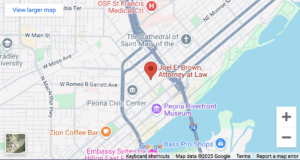
If an uninsured or underinsured driver hurt you, your next conversation with your insurer matters, and it shouldn’t be the first time anyone reads your policy. Joel E. Brown, P.C. is at 416 Main Street, Suite 927, in downtown Peoria, and Joel aims to meet with qualified callers in person within one business day.
Call (309) 673-4357 for a free consultation, and bring your declarations page if you have it.