After a serious fall on someone else’s property, you deserve a straight answer, not a sales pitch. As a Peoria premises liability lawyer, Joel E. Brown starts by honestly telling you whether you have a case, because a fall alone doesn’t automatically create one.
Illinois law requires proof that a property owner knew or should have known about a hazard and failed to fix it or warn about it within a reasonable time. Joel has spent 34 years practicing law, learning to separate real claims from those that insurers will decline.
We tell clients at the first meeting, free of charge, what kind of claim they have. Call (309) 673-4357 to find out where your case stands.
Does a Fall Automatically Mean You Have a Case in Illinois?

A fall on someone else’s property does not automatically give you a case in Illinois, and that is the most common misunderstanding we hear from new clients. Illinois law does not separate visitors into invitees and licensees, so the question isn’t what label applies to your visit. The question is whether the owner acted reasonably, and reasonableness gets judged against what a careful property owner would have done with the same information available at the time.
Under the Illinois Premises Liability Act, a property owner must take reasonable steps to keep the premises safe for people lawfully on the property. That generally means inspecting for hazards on a reasonable schedule, fixing known problems within a reasonable time, and warning visitors about dangers the owner has not yet corrected.
It does not mean every uneven sidewalk square or every spill creates automatic liability the moment someone gets hurt. Courts look at how long the hazard existed, whether it was obvious, and whether a reasonable inspection routine would have caught it. Joel works through those questions with you at the first meeting, so you know early whether the facts support a claim.
What about trespassers and children?
Adult trespassers generally fall outside this protection. Under long-standing Illinois case law, an owner generally owes an adult trespasser only a duty to refrain from willful and wanton conduct, meaning conduct that shows conscious disregard for someone’s safety.
Children are the significant exception. If a hazard on the property would predictably attract children, such as an unfenced pool, an abandoned appliance, or construction equipment left accessible, the owner can still owe a duty even to a child who entered without permission. Illinois courts decide these cases by asking whether the owner could foresee that children would be drawn to the danger, a rule sometimes called the attractive nuisance doctrine.
Why We Focus on Serious Premises Cases
We don’t take every slip-and-fall that comes through the door. A weak claim costs a client months and rarely results in anything meaningful, so we would rather say so in the first conversation than after a long stretch of false hope.
The cases we take on involve real, documented injuries: a fracture, a head injury, a fall down stairs, a dangerous condition that should have been fixed long before anyone got hurt. When Joel takes one of those cases, here is what you can count on:
- You hire Joel, not a firm. Joel E. Brown handles your case himself, backed by 34 years of experience, and you will not be handed off to a case manager.
- You meet face to face. Joel prefers to sit down with clients in person, works to schedule that meeting within one business day of a qualified call, and will travel to you if your injuries keep you home.
- Your fee does not change. Joel charges a flat contingency percentage, with no fee increase if he files a lawsuit or takes your case to trial.
- He files suit when it helps you. On serious injury cases, Joel often files early to gain subpoena power and a trial date instead of waiting on an insurer’s timeline.
- He is licensed in Illinois and Missouri.
- The National Trial Lawyers and the Million Dollar Advocates Forum have recognized him.
Every case turns on its own facts, and no lawyer can promise a particular outcome.
Joel puts it this way: “I can’t do anything about what happened yesterday, but I can affect your tomorrow.”
The evaluation costs nothing, even if the answer is that you don’t have a strong claim. Call (309) 673-4357 and we will tell you where you stand.

What Makes a Property Owner Liable in a Peoria Premises Case?
The evidence that wins a premises case almost always comes down to one question: how long the hazard existed before you got hurt. A spill that happened 30 seconds before you walked through it is very different from a puddle that sat for two hours while employees walked past it.
This concept is called notice. It can be actual, meaning the owner already knew about the problem, or constructive, meaning the hazard existed long enough that a reasonable inspection routine should have caught it.
Common scenarios we investigate around Peoria and the surrounding towns include:
- Winter ice on commercial walkways, parking lots, and apartment complexes, where Illinois law generally protects owners from natural snow and ice accumulation but not from ice made worse by a broken gutter, a poorly graded surface, or a removal attempt that left conditions worse than before
- Poorly lit stairwells and parking structures in older downtown buildings, where inadequate lighting can turn an ordinary staircase into a foreseeable hazard
- Negligent security at apartment complexes or businesses with a known history of criminal activity on the property, where warning signs went unaddressed before an assault occurred
- Retail store hazards that lead to a slip and fall, including unaddressed spills, unsecured merchandise displays, and broken flooring that went unrepaired after management was on notice
Negligent security claims are the hardest of these to build. Illinois does not hold a property owner responsible for every crime that happens on the premises, only for foreseeable harm, given what the owner already knew.
That usually means pulling police call records for the address, prior tenant complaints, and any earlier security assessment the owner already had in hand. Police and city records often exist before they show up in the owner’s records, which is why Joel requests them early rather than waiting until a lawsuit is filed.
What to Do Right After a Fall, Before You Call Anyone Else
The evidence that makes or breaks a premises case is often gone within hours, so a few immediate steps matter more than most people realize.
If you can safely do so:
- Photograph the hazard itself, not just your injury, before anyone has a chance to clean it up or repair it.
- Get the names and contact information of anyone who saw what happened, since employees sometimes aren’t allowed to give witness statements later.
- Ask that an incident report be created, and request a copy, or at least the report number, before you leave.
- Seek medical attention promptly, even if the injury seems minor at first, since delayed treatment gives insurers an opening to argue your injury was not caused by the fall.
You do not need a lawyer beside you to take these steps, and even a few of them can change how strong your case looks a month later. Once you call, Joel handles preservation letters and records requests that an injured person usually cannot get on their own.
What Compensation Is Available After a Premises Injury in Illinois?
A premises claim can include both economic and non-economic damages. Economic damages cover medical bills, lost income, and the cost of future care your injury requires. Non-economic damages cover pain and suffering, disfigurement, and the loss of activities you used to enjoy before the fall.
Putting a number on future care and lost earning capacity takes medical records and often testimony from treating doctors. Joel builds that record so the insurer’s estimate is not the only one on the table.
When punitive damages apply
In cases involving reckless conduct, such as a landlord who left a collapsing staircase unrepaired after repeated written warnings, Illinois law also permits punitive damages. Courts reserve these for willful and wanton conduct, such as intentional harm or a conscious disregard for safety, not ordinary carelessness.
Illinois does not let a plaintiff simply ask for them in the original complaint. Under735 ILCS 5/2-604.1, you must move the court for permission within 30 days after discovery closes and show a reasonable likelihood of proving facts that support the award.

How Shared Fault Plays Out in a Peoria Fall Case
A Peoria jury can reduce your award if it finds you were partly to blame for a fall, and property owners and their insurers raise that argument in most cases. They point to whether you were paying attention, wore appropriate footwear, or were in an area open to visitors.
Illinois follows a modified comparative fault rule: you can still recover as long as you were not found more than half responsible, though your award is reduced by whatever percentage of fault a jury assigns to you.
How a fault percentage changes the math
Say a jury values your damages at $100,000 and finds you 20% at fault for not watching where you stepped. Your recovery drops to $80,000. If the jury puts your share above 50%, you recover nothing, which is why insurers push so hard on this issue.
Because that argument is so common, building an early record, through photographs of the hazard, incident reports, and independent eyewitness accounts, matters more here than in almost any other injury claim.
How Long Do You Have to File a Premises Liability Claim in Illinois?
The statute of limitations, the legal deadline to file suit, runs two years from the date of injury for most Illinois personal injury claims, including premises cases. Exceptions can change that deadline, including for injured children and for falls on government property, as the table below shows.
| Where you were hurt | Filing deadline | Illinois law |
| Private property, such as a store, apartment complex, or home | Two years from the injury to file a lawsuit | 735 ILCS 5/13-202 |
| Property owned by a city, county, park district, school district, or other local public entity | One year from the injury to file a lawsuit | 745 ILCS 10/8-101 |
| State of Illinois property | Written notice to the Attorney General and the Court of Claims clerk within one year, unless the claim itself is filed within that year, and the claim filed within two years | 705 ILCS 505/22-1 and 505/22 |
| Any private property, when the injured person is a child | Two years after the child turns 18 | 735 ILCS 5/13-211 |
Property conditions also change fast. A hazard gets repaired, surveillance footage gets overwritten on a routine cycle, and employees who witnessed what happened move on within months. The earlier we document the scene, request records, and speak with witnesses, the stronger the case tends to be, whether it resolves in negotiation or at trial in the Tenth Judicial Circuit.
Peoria County sits in the Tenth Judicial Circuit, which also covers Marshall, Putnam, Stark, and Tazewell counties. Peoria County civil cases are filed at the courthouse on Main Street, a few blocks from Joel’s office, and he also handles cases filed in neighboring Tazewell County.
FAQs: Peoria Premises Liability Lawyer
Below are answers to specific questions that come up often in Peoria premises cases, beyond what is covered above.
Is a property owner responsible for snow and ice that fell naturally?
An Illinois property owner generally is not responsible for snow and ice that accumulated naturally from weather alone, under what courts call the natural accumulation rule. On commercial property, that protection ends when the owner worsens the hazard, and theSnow and Ice Removal Act separately shields residential owners who clear abutting sidewalks.
What if the business blames me for not seeing the hazard?
A business that says you should have seen the hazard is arguing it was open and obvious, and in Illinois that argument does not automatically defeat a premises claim. Illinois courts recognize exceptions when the owner should have expected visitors to be distracted, such as by store displays, or to face the danger anyway because they had no reasonable alternative. Whether one of those exceptions applies often decides whether the claim survives summary judgment.
Can I file a claim if I fell at a friend’s or relative’s house?
An injured guest can bring a premises liability claim against a friend or relative in Illinois, and the homeowner’s or renter’s insurance policy usually covers it rather than the owner paying out of pocket. Many people hesitate to come forward for fear of hurting the relationship. In most cases, you deal with an insurance adjuster, not your friend or family member.
What if the hazard was inside an apartment I was renting?
In Illinois, landlord liability depends on the lease terms and on who controlled the area where you were hurt. Common areas such as hallways, stairwells, parking lots, and shared laundry rooms typically remain the landlord’s responsibility even when the rented unit itself does not.
Do I need to report the incident to the property before I can sue?
Illinois does not require you to report a fall to the property owner before suing in a private premises case, though reporting it right away and getting it documented in writing helps later if the owner claims they never knew anything happened. Falls on government property are different, because the shorter one-year deadline makes prompt action more important.
Find Out If Your Case Is Worth Pursuing

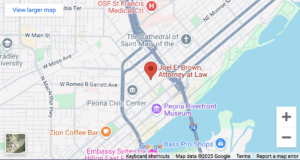
If you were hurt on someone else’s property in Peoria, get an honest evaluation before discussing what a case might be worth. Joel E. Brown meets prospective clients in person and works to schedule that first meeting within one business day, either at his office at 416 Main Street, Suite 1300, in downtown Peoria or wherever your injuries make it easier to talk.
There is no charge to sit down with Joel, and if he takes your case, you pay no fee unless he recovers money for you. Call (309) 673-4357 to talk through what happened and where your claim stands.